Big Bear Vans
Loading your next adventure
Big Bear Vans
Loading your next adventure
Big Bear Vans
Loading your next adventure
Connect With Us
Talk with our experts in Big Bear, California, about financing, test drives, and personalized upgrades.
Date
Time
Details
Review
Support Line
+1 (951) 441-9719
Please sign in with Google to manage your bookings.
Tell us what’s on your mind!
320 W Big Bear Blvd, Big Bear, CA 92314, USA
Big Bear Vans
Loading article

Expert Journal
Section 1
Choosing the right all-electric cargo van for your campervan involves careful consideration, especially when torn between the E-Transit Van and the E-Sprinter Van. Both vehicles offer zero-emission solutions and generous cargo space, making them appealing choices for environmentally conscious businesses. To make an informed decision, it's essential to delve into the body sizes, styles, interior features, and cargo-carrying capacity of these electric vans, ensuring that the chosen vehicle aligns seamlessly with your campervan requirements.
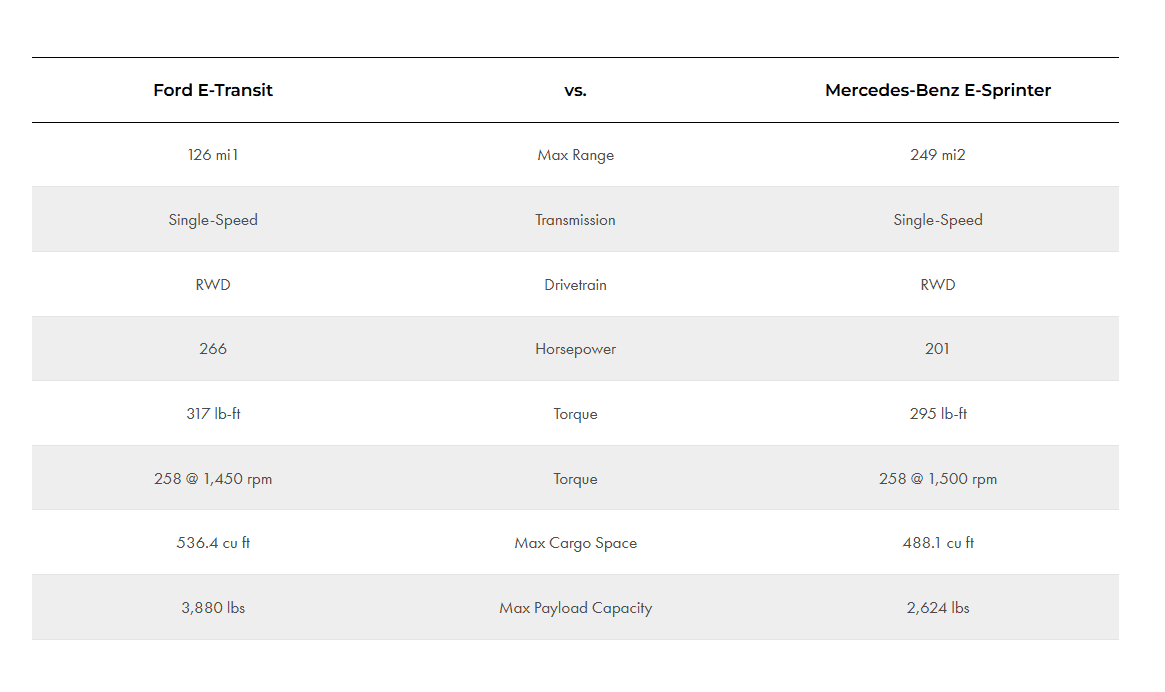
Deep Dive
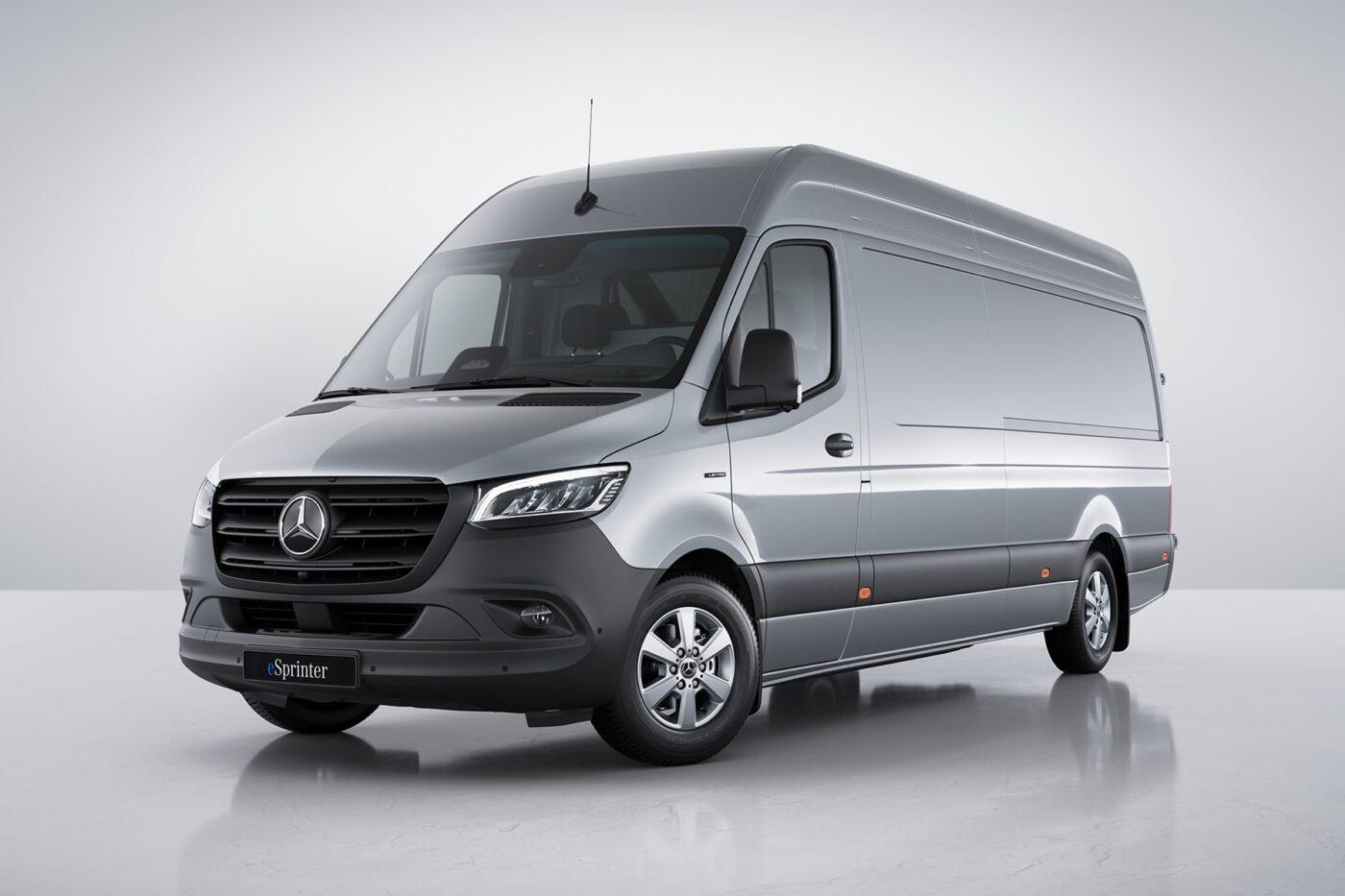


The E-Sprinter impresses with its decent driving range, spacious cargo area, and unexpected agility for its size.
The need for patience when accelerating to cruising speeds and the absence of multiple size options. Additionally, there is no passenger-hauling version available for those needing such functionality.


Mercedes-Benz introduces the E-Sprinter electric van to the US market in 2024, electrifying its renowned cargo hauler. While externally similar to its gas-powered counterpart, the E-Sprinter features a new architecture housing a 113.0-kWh battery pack beneath and a rear-wheel-drive electric motor. The driving range, expected to be around 230 miles per charge, caters to local deliveries and tradesmen. Available in high-roof cargo-van configuration, the E-Sprinter offers a choice between a 134-hp version and a high-output 201-hp version, with the latter recommended for enhanced performance. Standard features include a heated driver seat, USB-C ports, and a load-adaptive electronic stability control system, making it a compelling option for businesses embracing electric mobility.
Deep Dive
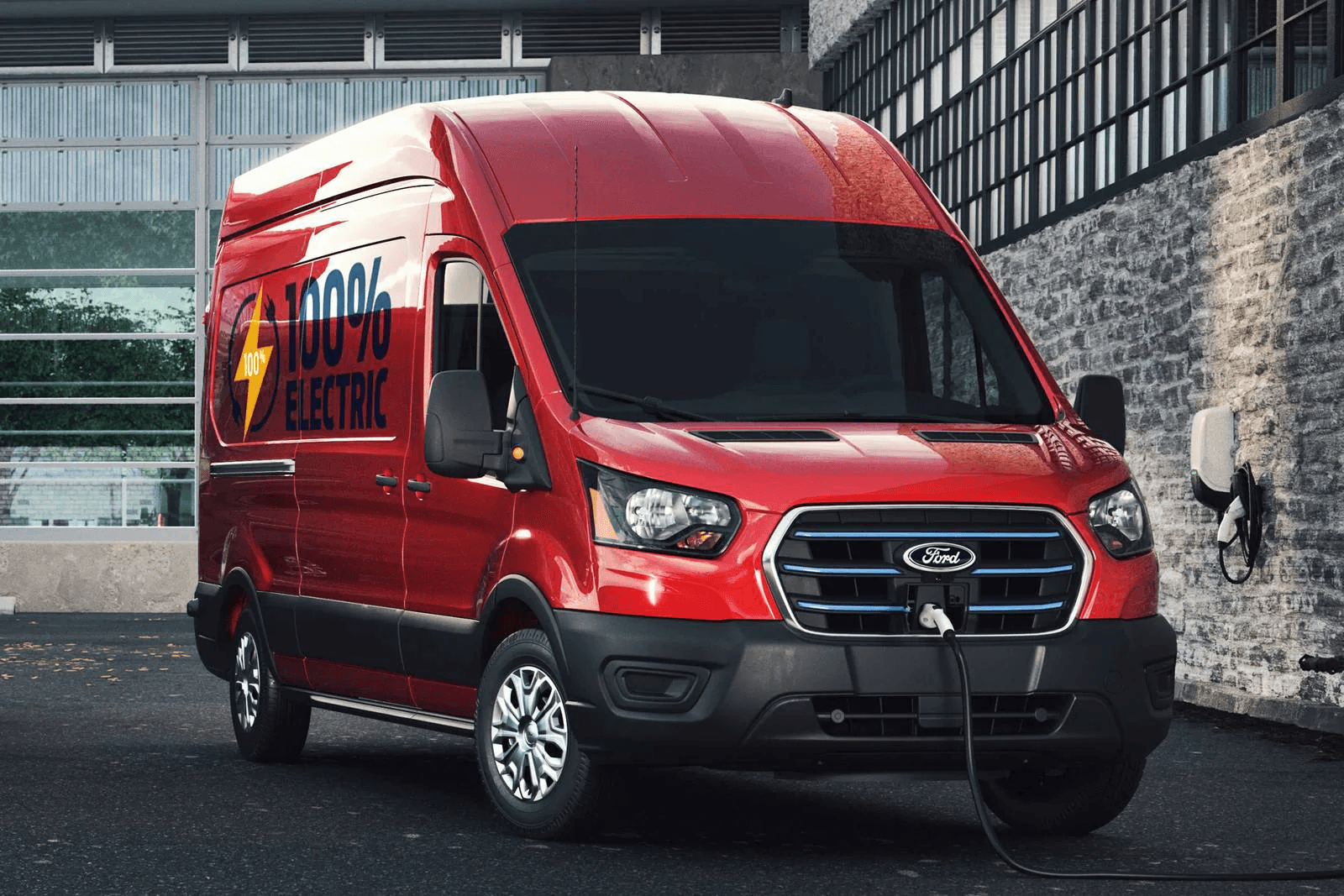


The Ford E-Transit offers emissions-free cargo hauling, making it an environmentally friendly option for businesses. It provides a spacious interior, accommodating various cargo needs. Moreover, it comes with an accessible price tag, offering value for budget-conscious buyers.
However, it falls short in driving range compared to some competitors and lacks towing capability. Additionally, it's not available as a passenger van, limiting its versatility for certain applications.


The Ford Transit, born from Ford's rich history of crafting sturdy delivery vehicles and high-performance cars, has transformed from Britain's notorious getaway van, historically linked to bank heists, into a popular and cost-effective choice for comfortable camper vans in the present day. Combining robust power, a smooth driving experience, elegant styling, and affordability relative to the Sprinter, the Transit boasts advanced safety and entertainment technologies, including automatic braking, pedestrian detection, and Wi-Fi hotspots. Introduced in the U.S. in 2014, the Transit cargo van offers versatility with options like rear-wheel drive, two wheelbases, three lengths, and three roof heights, providing users with customizable configurations to suit their van life needs. Whether opting for a standard 6-cylinder gas engine or an eco-boost upgrade and choosing between rear-wheel drive or AWD, the Ford Transit presents a comprehensive solution for a diverse range of preferences in the world of van living.
Section 35
The base E-Sprinter features a rear-wheel-drive electric powertrain generating 134 horsepower, with an optional more potent 201-hp version also available. Positioned between the front and rear axles, a 113.0-kWh battery pack powers the E-Sprinter. Despite its power options, the van is limited to a top speed of 75 miles per hour. While acceleration may require some patience, especially when fully loaded, the handling is surprisingly controlled for a vehicle of its size. During testing, we found the ride to be well-damped, with body roll effectively managed. Based on our test drive of the E-Sprinter, we project it will achieve a 0-60 mph time of approximately 12.7 seconds with the more potent motor. Opting for the entry-level 134-horsepower version is expected to extend this duration by several seconds.
The Ford E-Transit employs a single-motor, rear-wheel-drive configuration, delivering 266 horsepower, slightly less than the standard Transit's 275-horsepower gasoline V-6. However, it boasts 317 pound-feet of torque, surpassing the gas engine's 262 pound-feet output. Notably, the electric motor provides full torque right from the start, unlike the gas V-6, which requires reaching 3750 rpm for maximum power. Ford has revised the suspension system from the gasoline-powered Transit to enhance handling in the E-Transit. As we await the opportunity to test drive the E-Transit, we'll provide detailed driving impressions.
Section 37
The E-Sprinter provides 488 cubic feet of cargo space, slightly less than the gas Sprinter's 533-cu-ft capacity. Its maximum payload capacity of 2,624 pounds is less than half that of the gas-powered Sprinter but still offers ample cargo room. Additionally, its towing capacity of 4,200 pounds falls short of the gas Sprinter's capability.
While Ford of Europe cites a maximum tow capacity of 4,409 pounds for the overseas version, towing isn't recommended for the E-Transit sold in the U.S. Instead, the cargo van offers a maximum payload of 3,880 pounds, while the cutaway model ranges up to 4,513 pounds.


Section 43
The official EPA range estimate hasn't been released yet, but it's anticipated to be around 230 miles per charge. Mercedes claims the battery can be charged from 10 percent to 80 percent in 42 minutes with a DC fast charger. However, a completely depleted battery will take over 12 hours to charge using a conventional 240-volt outlet.
The Ford E-Transit is equipped with a 68.0-kWh lithium-ion battery, providing a range of up to 126 miles per charge according to Ford. For charging convenience, Ford offers a mobile charger for home use and plans to provide a more powerful charging station for installation in buyers' garages. Drivers also have the option to recharge at public charging stations. Ford claims that using a 115 kW DC Fast Charger, the battery can be charged from 15% to 80% capacity in just 34 minutes, while a 50 kW DCFC takes 65 minutes for the same charge. Level 2 charging with a 48-amp circuit is estimated to take eight hours for a full charge, while a 30-amp L2 circuit requires 12 hours.
Section 45
As the EPA doesn't provide fuel economy ratings for commercial vehicles like the E-Sprinter, its real-world fuel economy remains to be tested.
As the EPA doesn't provide fuel economy ratings for commercial vehicles like the Ford E-Transit, its real-world fuel economy remains to be tested.


Section 51
The E-Sprinter is available solely as a long-wheelbase van with a high roofline, providing 488 cubic feet of cargo space, which closely rivals the regular Sprinter's 533 cubic feet. While it offers a Mercedes-level of interior refinement compared to its main rival, the Ford E-Transit, it doesn't quite reach the luxury standards of the S- or even C-class models. However, it does come with options to enhance the delivery experience, including heated and pivoting front seats, a heated windshield, electric folding exterior mirrors, air-conditioning, an electric sliding door and step, a digital rearview mirror, and more.
Unlike its gasoline-powered counterpart, which provides various interior configurations, the E-Transit is currently limited to seating for just two individuals. However, this trade-off results in ample cargo capacity, particularly in the extended-wheelbase, long-body model with a high roof, offering more than 487 cubic feet of cargo room. For those requiring less cargo space, there are options for regular or mid-length body sizes with standard or mid-height roofs. Inside, the E-Transit features a utilitarian design with rubberized flooring, durable plastic trim, and cloth seat upholstery, emphasizing its focus on practicality. Nonetheless, its relatively smooth suspension and car-like interior elements contribute to a more comfortable driving experience for a work vehicle.
Section 53
The E-Sprinter showcases Mercedes-Benz's cutting-edge infotainment software, incorporating a voice control assistant for seamless operation. Alongside voice control, users can navigate the system using a touchscreen, touchpad, and touch-sensitive buttons on the steering wheel. An optional 10.3-inch touchscreen display provides an enhanced interface, and cloud-based services cater to fleet owners' needs, offering advanced features and connectivity options.
All E-Transit models feature a standard 12.0-inch infotainment system, offering a larger and more advanced interface compared to the regular Transit's optional 8.0-inch display. Powered by Ford's latest Sync 4 operating system, this system provides seamless connectivity and functionality. Additionally, an onboard 4G LTE modem transforms the van into a Wi-Fi hotspot, while a complimentary three-year subscription to Ford Pro E-Telematics offers essential vehicle data and tracking capabilities for fleet managers. One notable feature is the vehicle preconditioning function, allowing users to set interior climate and other parameters while the van is still connected to the charger, optimizing battery charge and enhancing overall efficiency and range.


Section 59
The Mercedes E-Sprinter is equipped with a suite of standard driver-assistance technologies aimed at enhancing safety for both the driver and passengers. Among these features are automated emergency braking, blind-spot monitoring, and a driver-attention monitor. The automated emergency braking system can intervene in critical situations by applying the brakes if an imminent collision with another vehicle or obstacle is detected, potentially reducing the severity of or even preventing accidents. Blind-spot monitoring technology helps drivers by detecting vehicles in their blind spots and providing alerts to assist with safe lane changes, thereby reducing the risk of side-impact collisions. Additionally, the driver-attention monitor continually assesses the driver's behavior and alerts them if signs of drowsiness or inattention are detected, helping to mitigate the dangers of fatigue-related accidents. These standard safety features contribute to making the Mercedes E-Sprinter a reliable choice for those prioritizing safety in their commercial or personal transportation needs.
The Ford E-Transit is equipped with Ford's Co-Pilot360 suite of standard driver-assistance features, providing a foundation of safety for drivers and passengers alike. In addition to these standard features, the E-Transit offers a range of available safety enhancements, including speed limiting, navigation with traffic sign recognition, and blind spot assist. Notable standard safety features include automated emergency braking, which can help prevent or mitigate collisions, and lane-departure warning with lane-keeping assist, which helps drivers stay safely within their lanes. Furthermore, the availability of adaptive cruise control with traffic sign recognition adds an extra layer of convenience and safety by assisting with maintaining a safe following distance and keeping drivers informed about relevant traffic signs. For those seeking more information about the E-Transit's safety performance, resources such as the National Highway Traffic Safety Administration (NHTSA) and the Insurance Institute for Highway Safety (IIHS) websites provide comprehensive crash-test results and safety ratings.
Section 61
The E-Sprinter is available solely as a long-wheelbase van with a high roofline, providing 488 cubic feet of cargo space, which closely rivals the regular Sprinter's 533 cubic feet. While it offers a Mercedes-level of interior refinement compared to its main rival, the Ford E-Transit, it doesn't quite reach the luxury standards of the S- or even C-class models. However, it does come with options to enhance the delivery experience, including heated and pivoting front seats, a heated windshield, electric folding exterior mirrors, air-conditioning, an electric sliding door and step, a digital rearview mirror, and more.
Unlike its gasoline-powered counterpart, which provides various interior configurations, the E-Transit is currently limited to seating for just two individuals. However, this trade-off results in ample cargo capacity, particularly in the extended-wheelbase, long-body model with a high roof, offering more than 487 cubic feet of cargo room. For those requiring less cargo space, there are options for regular or mid-length body sizes with standard or mid-height roofs. Inside, the E-Transit features a utilitarian design with rubberized flooring, durable plastic trim, and cloth seat upholstery, emphasizing its focus on practicality. Nonetheless, its relatively smooth suspension and car-like interior elements contribute to a more comfortable driving experience for a work vehicle.


Section 67
Mercedes-Benz's warranty offerings for the eSprinter strike a balance between industry norms and extended coverage, providing a mix of standard and exceptional protection. While the limited warranty of four years or 50,000 miles aligns with typical offerings in its class, the powertrain warranty stands out for its longer duration, also covering four years or 50,000 miles. This extended coverage offers owners added assurance regarding essential components' durability and performance. Furthermore, the extended warranty for electrical components, spanning eight years or 100,000 miles, reflects Mercedes' commitment to ensuring the reliability of critical systems in the eSprinter. However, it's important to note that Mercedes does not include complimentary scheduled maintenance, necessitating owners to budget for routine upkeep. Nonetheless, the extended warranty coverage for the powertrain and electrical components helps mitigate potential long-term expenses, enhancing the overall value proposition of the E-Sprinter.
Ford's warranty package for the E-Transit aligns with industry standards while also offering extended coverage for key components, providing a mix of typical and exceptional protection. The limited warranty, lasting three years or 36,000 miles, falls within the norm for the automotive industry. However, Ford distinguishes itself with a longer powertrain warranty, covering five years or 60,000 miles, offering added reassurance for essential drivetrain components. Particularly noteworthy is the extended warranty for battery components, extending for eight years or 100,000 miles. This extended coverage underscores Ford's confidence in the reliability of the E-Transit's battery system, crucial for electric vehicles. Although Ford does not include complimentary scheduled maintenance plans, the extended warranty coverage for powertrain and battery components helps offset potential long-term maintenance expenses, enhancing the overall value proposition of the E-Transit.
Section 69
Comparing the Ford E-Transit and the Mercedes-Benz E-Sprinter provides valuable insights into the strengths and weaknesses of each van, helping potential buyers determine which best aligns with their commercial vehicle needs. While both vehicles offer electric-powered solutions for businesses, they have distinct features and capabilities to consider. The Ford E-Transit boasts competitive pricing, robust powertrain warranties, and a range of configurations, making it a versatile option for various applications. On the other hand, the Mercedes-Benz E-Sprinter offers impressive battery capacity and cargo space, appealing to those prioritizing range and storage capacity. Ultimately, the choice between these electric vans depends on factors such as budget, intended use, and preferences for features and warranties. By evaluating the specific requirements of your business or individual needs, you can make an informed decision about which van is the most suitable fit for you.
Spread the knowledge with your fellow van-lifers.